Thursday, May 8, 2008

Mister Lonely


Directed by Harmony Korine
Written by Harmony Korine and Avi Korine
UK, France, Ireland, USA; 2007


A little over three years ago I was able to catch Harmony speaking at Ryerson University in Toronto. It was a fantastic Q & A session, hosted by Bruce LaBruce, who is awesome. Clips from Harmony's (ridiculously few) films played on the screen above the two, and it was the first time the filmmaker had actually watched any of the work since the bygone era in which he made it. He cringed, literally, after some of the harder-to-digest bits, but there was an unmistakably proud sparkle in those eyes as well. He mentioned a film in the works, a sad tale he was writing with his brother Avi, about celebrity impersonators living on a commune in France. Flash forward to last Saturday, when New York and I caught up with Mister Lonely, a film that's just exactly what he promised it would be. The shotgun semiotic technique—where art direction and a shooting script are replaced by a grocery list of iconic symbols—has been Harmony's signature in the past, and this newest piece may be a step removed from his first two films, but it's still a fine continuation of tradition. A young Buckwheat impersonator recalls many of the strange and semi-improvised Gummo performances, only this time feels more organic as a stand-in for Harmony himself, who was apparently raised on a hippie commune before his famous sojourn in New York City. Fate, free will, and personal choice comprise solid thematic ground on which much of the film rests, a nice change from the lily pond of content that makes up all of Harmony's other work. There are still a lot of nice Gummo moments, though, like the scene of Larry, Curly, and Moe shooting the sheep, or Sammy Davis Jr. dancing on the roof. In fact any scene including the impersonators, which is nearly every scene of the film, takes on the hyper-reality characteristic of Harmony's method. Other icons include The Pope, The Queen, and an Abe Lincoln who drops the F-bomb like it was slavery laws.

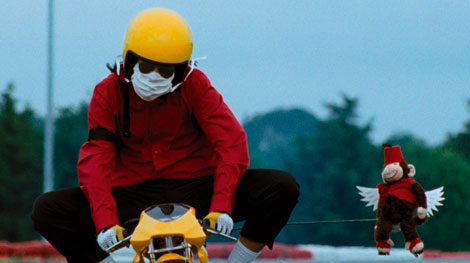
Werner Herzog makes another appearance, this time as an overzealous but well-meaning missionary somewhere in the Spanish-speaking jungle. See this film, if for no other reason than to experience his introductory scene—not so much a Harmony move, but more of a classic Herzog one. A local man (this is all documentary footage, I'm guessing, probably just a local Panamanian hanging around the set that they befriended) is prompted to confess his infidelity and plead forgiveness from Father Herzog, in costume with the camera rolling. The man eventually admits to having cheated on a woman, while tears stream down his cheeks. Herzog plays it straight, says a prayer in Latin, and absolves the man of all sin. Un-fucking-real. Next are the nuns, falling out of airplanes unscathed, basking in God's grace as they careen through the grainy blue sky on bicycles in some of the most beautiful photography of the film. Of the film? Try "of the year," for that matter. Cinematographer Marcel Zyskind is a usual Michael Winterbottom collaborator, and A propos, definitely take a look at both of these guys' work. Mister Lonely's photography is absolutely gorgeous, though. Highlight of the film by far. In the spirit of indulgence Zyskind goes old school, uses big-ass lenses, with shallow depths of field, loves slow motion, gets a little grainier than Gummo's Escoffier (may he rest in peace), but not as much as julien d-boy's Anthony Dod Mantle, a DP Zyskind worked for on 28 Days Later as it turns out. Take one look at the opening shot, Diego Luna's Dangerous-era Michael Jackson riding a tiny motorbike with a stuffed monkey attached to the back, all coming at you in ultra-slo-mo. Un-fucking-real.

Harmony spoke at Saturday's screening as well: "After tonight, I'm going to go home and write another movie. I'm not going to be so precious about things any more." In regards to his body of work, he took the words right out of my mouth. And in regards to the other movie, I'm certainly looking forward to it.

Awesome things I didn't mention:
Denis Lavant as Charlie Chaplin was great.
Leos Carax as a creep was perfect.
Samantha Morton gained weight for the Marilyn role, but she is still such a doll.
What was with the talking eggs?

Wednesday, May 7, 2008

My Winnipeg


Written by Guy Maddin and George Toles
Directed by Guy Maddin
Canada; 2007


Winnipeg's night skyline is framed by the window of Mr. Maddin's (played by an actor but actually narrated by the filmmaker himself this time) sleeper car on a passenger train on an endless loop around the city, like a thought bubble above his restless noggin. You sure can't take the city out of the boy, but apparently you can't quite take the boy out of the city, either. The loop is something of a fitting metaphor for the paradox of light rail in North America, where the Canadian public transit ridership is two to three times what it is in comparable American cities, but the public spending on infrastructure and upkeep in Canada is only about half that of its southern neighbor. That's a hard, sourced fact, something Mr. Maddin certainly won't give you. Disproving truth, or what cinema conventions would usually tell us is true, is basically his m.o., and in this newest film he's taken it to the next level, telling flat out lies about his hometown and its history. This self-narrated hodgepodge of experimental docu-fantasia (that's the term he uses) describes what we Americans would recognize as the de-industrialized capital of a midwestern swing state (do they have those in Canada?). The city has fared well, it seems, through a mad century of capitalization and subsequent demolition at the hands of those storybook robber barons, the department store speculators.

Those robber barons. Robber barons that have subsequently demolished the city. This narrated track (I'm so upset I missed the live narration performed only once at Tribeca this year, by the way. I was probably at that stupid Pangea Day thing. Doesn't anyone else see this crap as globalization? Anyway...) this narrated track is written with such repetitive eloquence. The phrases and rephrases are almost like chapter headings. At this point in Guy Maddin's career, though, his stylistic moves are no longer groundbreaking, and really only serve as branding while we experience the unique elements of each piece. It is exactly this fact that allows My Winnipeg to work so nicely as an essay, for one, because it's not necessarily about putting together a cohesive film experience, but more about reconciling a specific set of ideas while the hodgepodge illustrates. This is a technique perfected from the inside out by Su Friedrich in 1990's Sink or Swim, a film in which Freudian parent-child relationships, personal insecurities, and the idea of the innocent persona in the big bad world are all intellectual and emotional issues (as in Maddin's best work, Careful, The Heart of the World, My Father is 100 Years Old), rather than, however funny, mere jokes (as in his less successful Cowards Bend the Knee, and Brand Upon the Brain!). There are extremely funny moments here, especially during the NHL sequences and the domestic reenactments, which are both somehow bizarre and familiar at the same time, recalling the very best David Lynch moments, or perhaps a Kurt Vonnegut description of a dying family in a dying city. This is another move in the right direction for Maddin, and if his methods—once so mind-blowing but now old hat—can keep pace with his mad rush of ideas, than we can expect the delights to continue.

Tuesday, May 6, 2008

Profit Motive and the Whispering Wind


Written and Directed by John Gianvito
USA; 2007


A sad quality of Americana is that it's only a celebration of a diffuse slice of our history, the one in which Henry Ford's preserved historical villages don't include union organizer meetings, Norman Rockwell's The Problem We All Live With doesn't include cops spraying lunch counter patrons with firehouses, and Superman fights communists while holding down a day job as a yellow journalist. It's a sad fact, too, that most history books tell the rich people's established version of history, perhaps because it's easier to research than it is to launch investigations into how the other half lived. Just ask Howard Zinn what kind of a process that involves, or ask Chris Harman. Uncovering what the ruling class would have preferred us to forget is borderline revolutionary! There are so many people that history has forgotten to mention, either out of laziness or a concentrated effort by powerful interests, that it doesn't seem at all possible for it not to repeat itself. And when we're talking about business interests, isn't that the idea? Andrew Carnegie named a school after himself, Reagan branded an economic paradigm, and Sam Walton's legacy is as strong as his market share, but what kind of institutions are keeping alive the name of Lucretia Mott? How many students learn the name of Uriah Smith Stephens, the founder of the Knights of Labor, one of the first successful national labor unions in the country? This national hero is buried in an unmarked grave in Philadelphia. Not only has history misplaced him, but it has also failed even to label his remains.

John Gianvito's stunning Profit Motive and the Whispering Wind was the New York Society of Film Critics' Best Experimental Film of 2007, and rightly so. Here is a dedicated soul, and passionate filmmaker, who not only knows how to construct a powerful cinematic experience, but is also one of the rare historians willing to trek through miles of weeds and historical records in order to find these unmarked graves. Gianvito, a teacher at Emerson, set about to make a very different kind of documentary, but was taken aback by the kind of treatment history has shown not only the two aforementioned heroes, but dozens of others including Henry David Throeau, Soujourner Truth, Fanny Lou Hamer, Cesar Chavez... the list goes on and on. Gianvito decided to concentrate only on the earthly remains of these labor organizers, civil rights activists, and humanitarians. PMATWW inter-cuts between snippets of the lonely grave sites and the delicate movement of wind through the pines and the grass that usually provide Americana with an artificial warmth. Under Gianvito's discerning video lens, these elements are quite cold and become quite eery by the end of the hour-long piece. Occasionally through the trees or behind a particular memorial we catch a glimpse of a McDonalds, or a WalMart. The end sequence is punctuated by common protest signs, popular movement, and community organization. Slowly, the title becomes that much more pertinent, and the loud cracking of the drums shakes us to the depths of our moral hearts. The film is dedicated to Howard Zinn's A People's History of the United States, and Gianvito is pleading with us not to forget those lessons learned therein.

Thursday, May 1, 2008

Standard Operating Procedure


Written and Directed by Errol Morris
USA; 2008


We're at a cultural point where intellectual coolness, a plea for middle America humanism, and blogs in the NY Times about the vague metaphysics of documentary photography can't justify a failure to make a real statement about why things are wrong in the world and who are the culprits. Mr. Morris, at a talkback after the Tribeca premier of his latest piece of polished softcore, made for great entertainment by pointing his finger to the ceiling and shouting in his characteristically cartoonish timbre (perhaps what the offspring of Betty Boop and Foghorn Leghorn would sound like): "This thing goes all the way to the top!" Apparently the PFC's responsible for the Abu Ghraib debacle can rest easy, because according to Errol Morris, George W. signed the Code Red. He also went on to name a CIA member involved in the torture proceedings hinted at in Standard Operating Procedure, although none of this stuff is in the actual film. He continued to generally made a bleeding heart lefty case for the untold human story. Sorry, Errol, but while 1999's Mr. Death was saved by a fascinating fringe aspect and the fact that Holocaust Revisionists are hardly ever taken seriously, in 2003 you had the devil himself on the stand and couldn't, or wouldn't, make him say what every progressive thinker in this country needed to hear. The Fog of War backed down from what could have been a revelation from the life of former Defense Secretary Robert McNamara, rather than a watered-down "lesson" where, among other silly pontificating, the modern world's colonial rottweiler tried to take Ralph Nader's credit for automobile safety rather than admit that it was he who orchestrated and perpetuated the Vietnam War, America's biggest ever foreign policy failure. Well, second biggest at least.

Which brings us to Iraq. Morris described at the Tribeca screening how he couldn't gain clearance for interviews with any of Abu Ghraib's offending GI's, nor did he find any Iraqis involved in the incidents, nor would any high-ranking US officials speak to his Interrotron (the camera and video playback system he uses for interviews so that it appears his subjects are speaking directly to the audience). I'm genuinely surprised nobody over in the Bush clubhouse would speak with him, considering how good he made McNamara look in 2003. Bush Sr. and his buddies are perfect protégés of the original empire gangster, maybe they could have used an Errol Morris film to improve public image in the eyes of lefties who cling to Errol Morris and his political jello-spine in the same way that people who shop at Whole Foods and build giant houses in the middle of untouched forests think they're environmentally-conscious. Anyway, Morris couldn't get any of those really good interviews, so he put together a crappy humanist story about the innocent 21-year-old privates who didn't do enough jail time for their lack of decency. He also made some half-assed comments about the power of photography and its ability to tell a story (but, shocking! it's not the whole story). Slap some Robert Richardson photography in there, close-ups of blood drops, an ace with Saddam's face, and a paper shredder. Call up Danny Elfman and ask him if he can do a Philip Glass impression. You've got yourself another hit, man. But instead of a real money shot, we're left only with simulated. Errol Morris is becoming the Shannon Tweed of the doc world.

Thursday, April 10, 2008

i saw this first...

My Blueberry Nights,
just in case you missed it. I saw this during its Asia release, because my life is so glamorous I spent four nights in Singapore catching up on movies..

Wednesday, April 9, 2008

Boarding Gate


written and directed by Olivier Assayas
France, Luxembourg, 2007


Sandra blurts out the point so obviously in the second scene that it completely takes the fun out of the subsequent ones. "You always got harder when you told me what we were going to do than you did when we actually did it." Great line, though. The story is more interesting in between the action sequences—of which there are few. I'm hoping, though, that this isn't merely an effect caused by Sandra's appearances in lingerie—of which there are many. Olivier Assayas' latest film in a career-tainting string of disappointments after 1996's Irma Vep (although I quite liked his Paris, je t'aime segment) flirts with redemption in a way similar to main character Sandra's vain, last-ditch attempt at the same. Assayas continues in BG to plug seedy sexual attractions, B-movie genre bends (self-admitted this time, as if he needs to remind everyone why he keeps making films at all?), and an anti-bombshell femme fatale into his usual formula. The resulting meta-fest ends up with its lead actors simply chasing each other around the x-axis, taking turns in the focus range. It resembles less an exploitation film and more a Directing for Film 101 final project. At least it's interesting until we decide who's chasing whom. One talent of Assayas', like so many critics-turned-filmmakers, is he really makes an audience leave the theater feeling smart as long as they understand what the hell just happened. Sandra whored herself around for a long time in her twenties, and now that she's burned out in her thirties she seeks, through that same lifestyle, to phase herself out of the game. Simple.

Asia Argento is so terrifyingly attractive, I'll forgive her butchering this potentially effective script. The photography and soundtrack fall under the same category. That is to say, effective on the surface. Assayas and fellow heady shooter Yorick Le Saux (I don't really know much of this guy's work. I only say "heady" because he's French, too) keep things either too dark to see far enough into the scene, or are careful to keep a sharp focus only on the foreground, leaving the rest completely indecipherable. An easy visual metaphor for surface beauty. For such a complex filmmaker, Assayas' techniques are usually fairly straightforward when broken down. Asia Argento is so terrifyingly attractive, I'll...(did I say this already?) Moving on, Asia Argento is so... I just can't shake it.

Anyway, Asia has been excellent before. I call in question The Heart is Deceitful Above All Things, a film where she played a convict with the kind of conviction it takes to bring to life not just a bad-girl (which she is anyway), but a real embodiment of desperation. BG doesn't see her with any commitment to this world. I'd call it a problem with theory-devotional filmmaking. Argento's foray into filmmaking shows something like holistic ignorance of a critical reception. It's a don't know/don't care attitude that really keeps a film like that one breathing. This one, like the rest of Assayas' career, is marked by a fear of commitment. Non-film theorists often make the best filmmakers. And for the record, in regards to Assayas' non-actors, well, let's just say Kim Gordon was WAY better on stage.

Thursday, March 27, 2008

Bob Muir and the Enemy Below


"That's just so wrong," say the T-shirts, the website, the people in the audience, etc. Bob stands to stage right, while The Enemy Below positions himself opposite. Sandwiched between these two irreverent scoundrels are Insect Girl (the evil hottie) and Trafalgar the Square (the good hottie). With S-Dog on keys and The Dude! rocking the skins in the back, this sex-tet (literally) combines rock and roll, burlesque, and poor, poor taste with a unique ease. "Chain me up, tie me to the bedpost/ Oh, whip my ass till it looks like a French Roast," I could go on for pages describing the demented genius in the songwriting, but lines like these speak for themselves. The band's modest mission is to "shock and amuse, nothing more," or so they claim. I had the supreme pleasure of a Bob Muir and the Enemy Below experience on Tuesday night at The Delancey, and not only am I shocked and amused, but I'm also befuddled, flabbergasted, disgusted, and totally aroused (all at the same time). I make fun, but honestly, the experience is one in a million, and the band is so fucking loveable I simply must go see them again at their CD release show, May 31st at Brooklyn's Luna Lounge, and you should too.

Check them out at myspace.com/bobmuirandtheenemybelow. Just so you can get a sense of what I'm talking about, here's a set list I stole from the stage floor after the show, amazing...

Set List

Thursday, March 20, 2008

CJ7

directed by Stephen Chow
written by Stephen Chow and Chi Keung Fung
Hong Kong 2008


Stephen Chow has always made grown-up movies that appeal to kids. Or maybe it's kids' movies that appeal to grown-ups. Or maybe his brand of unabashed stooge slapstick, a commitment to the campiest of visual effects, and an eye for the contemporary despite leanings toward a cultural universality (literally this time), are just the elements that happen to get results across the age spectrum. Chow's grown up characters, most notably the ones he himself plays, act in many ways like children, while his children fill the opposite role. And there are enough smarts, formal attention, and cinematic references included in the overall zaniness to keep the arthouse snobs coming back. It might sound a little like I'm describing the Pixar regime, but (thankfully!) there's an essential difference between Chow's work and that steaming pile of pandering Disney crap. Pixar films play to the lowest common denominator through a diffuse self-censorship made up of market research, focus groups, and tested material. Stephen Chow's films, despite their whimsy, take a large amount of risk, as many of the jokes don't land, the effects are at times over-the-top, and even narrative flow is interrupted in the name of whatever greater cinematic awesomeness seems to fit at the time. Where Chow's recognizable themes are used to sell a formal--and often personal--cinematic vision, Disney's sale is not quite as noble.

But CJ7 doesn't succeed the way Shaolin Soccer and certainly Kung-Fu Hustle do. For one, there's a morality tale happening, structured something like an Aesop Fable, that is never reconciled with the story. A remarkable and hilarious Jiao Xu plays Dicky, the kid whose adherence to a working class ethical code is blown apart with the introduction of a high-tech toy. There are some beautiful (and funny) allusions to the corrosive nature of power, but ultimately the moral material, which was loaded on so thickly from the outset, is either lost to melodrama during the father's accident, or a messy plot wrap-up during CJ7's exit. As usual, though, Chow's best moments come when he detaches from a conventional structure (Ieaving Pixar in the dust), and uses the elements of film like a kid would a Lego set. The closet-to-galaxy sequence is incredible, part DirecTV commercial, another part Flight of the Navigator. Dicky's father's 12 by 12-foot shack in the junkyard is ridiculous yet picture perfect (All the shots are from overhead! There's literally nowhere to put the camera! Amazing..). But Chow's struggle with narrative reconciliation is a losing battle. The attempt to ground such playful segments like Dicky's fantasy victories into a kind of plot framework is futile, and what was hilarious a second before suddenly becomes jarring. As usual, the supporting cast is perfectly side-splitting, and in this case gold stars go to Shing-Cheung Lee's role as the pathetic Mr. Cao. Chow's move away from the ensemble conventions is in this case what muddles the film, though there's a touching personal story in there somewhere.

Wednesday, March 19, 2008

Maldeamores


[written for Global Nomads at http://www.janera.com/]

directed by Carlos Ruiz Ruiz and Mariem Pérez Riera
written by Jorge Gonzales and Carlos Ruiz Ruiz
Puerto Rico 2007


Three twisting love stories make up Maldeamores, the most recent offering from a small Caribbean island not exactly known for its film scene. The Puerto Rico Film Commission would like to see that notion changed, though. Boasting the largest tax incentive of any community in the Caribbean, the PR government offers a 40% break for producers of cinema, television, and original soundtracks. How wonderful it is, then, that the first project born of this new plan is about as native Puerto Rican as they get. First-timers Carlitos (as he's affectionately billed) Ruiz Ruiz, and wife Mariem Pérez Riera not only direct this gem but appear in a comical opening sequence, laden with the kind of subtextual angst that only a married duo could muster. A silly argument over gum quickly results in near catastrophe on a mountain highway. The film continues without the pair, and follows three unconventional love stories on different parts of the island. The film's title translates into English as "Lovesickness", but what this film brings is certainly not the kind of sappy sentimentality with which that word is usually associated. A better translation would probably be "sickness from love." This opening bit is just a taste of the struggles to come, and if the kind of dark humor that absolves jokes involving neck braces isn't your cup of café con leche, perhaps you'd better steer clear of this one.

In story one, we're introduced to a grieving family. Well, at least Lourdes (Teresa Hernández) is grieving over her recently passed grandmother. Her adolescent son (Fernando Tarrazo) struggles with his tears in the back seat, more interested in putting on a big front to impress a darling cousin. Lourdes' husband Ismael is played by the only recognizable actor in the ensemble, Luis Guzmán, a Hollywood mainstay and PR native. A usually vibrant Guzmán this time only blandly fills the role of the unfaithful Ismael, but the standout is easily the exchange between Ms. Hernández and Norman Santiago, who plays her brother-in-law Macho. Santiago's clumsy ne'er do well is as vacant as the sun-bleached neighborhood, and Lourdes' temper only shortens. The relative obscurity of this cast certainly doesn't affect its impact, though. Next up is easily the shining star of the vignettes, a septuagenarian love triangle that depicts a hilarious exchange between a saucy--yet sensible--old flirt, her curmudgeonly companion, and to complete the trifecta, the most cavalier of ex-husbands, a model of that smoothly benign Caribbean machismo. His 70 years of likeability are quite infectious, and this lovely triangle resolves itself extremely well despite the difficulties. Silvia Brito's Flora, through obvious faults of her own, finds herself in the middle of a battle for her highly regarded attentions. On one side is Cirilo (Chavita Marrero), the mean-tempered but endearing live-in mate of Flora's. On the other side is Miguel Ángel Álvarez's charming Pellín, his abject advances--despite decades of delinquency--are only justified when he asks Flora an interesting rhetorical question, "Have you ever considered the fact that we're all going to die?" Love and death, some would say, are the only two questions to ask. It's in these moments that the film takes leave of its comic lightness and breaks into more interesting territory. For young filmmakers, Ruiz and Riera are tackling some very sophisticated themes.

The third vignette continues on the theme of love and death. The story centers around a daily bus passenger, Miguel, played by Luis Gonzaga. Despite an overly attentive mother, his loneliness drives him to an obsession with Marta, the driver (Dolores Pedro), and a suicide attempt becomes a hostage situation. Fortunately, Ruiz and co-writer Jorge Gonzales keep things on the lighter side and the situation devolves into a kind of wedding. Love, death, and hostages. Ruiz and Riera certainly don't shy away from depicting the omnipresent Virgin Mary watching over the affairs in supremely Catholic Puerto Rico. Maybe we're all hostages when it comes to love, and perhaps the filmmakers are posing the question as to whether maybe the Virgin isn't better off?

Despite some clunks, the three narratives complement each other well. An adulterous man loves too much, a bus driver too little, and three elderly socialites reflect on lives that included a little of both. Eduardo Alegría's and Omar Silva's score is marvelous in its simplicity, the piano an artistic accent rather than an emotional cue. Ruiz, Riera, and cinematographer P.J. López again rein in the arthouse indulgence on the photographic style, instead opting for a realistic impressionism that highlights performance and drama over heavy-handed camera work. This style, though, allows for those small observational details to translate nicely into some beautiful, yet fleeting, visual moments. It's almost as if the photogenic Caribbean beauty can't help but escape into the frame. Though in a film that centers around love, death, and hostages, perhaps escape isn't such a surprising thing.

Saturday, March 15, 2008

Paranoid Park


directed by Gus Van Sant
screenplay by Gus Van Sant
novel by Blake Nelson
France, USA 2007


What Gus Van Sant has done this time around is he's slightly shifted his main focus. Elephant, Last Days, and his more recent Paris, je t'aime segment are so interesting because they walk a fine line between familiarity and extreme strangeness. In 1942, Albert Camus imprisoned his "stranger" for a failure to assimilate, emotionally, thus removing him from the existential trap posed by the world. Van Sant has been positioning his own emotional strangers in what we would have assumed were familiar environments, and deliberately allowing them to remain, unbridled, until some inevitable natural dissonance. I'm seeing this latter phase as a transition from the formal ambitions of his earlier years to a more zen-like acceptance of the inconsistencies that represent a so-called "normal" life in the weirdness of today's upper middle class society. The past three releases have also seemed to drop that passionate devotion to the angst of youth in favor of a clinical indifference. This quiet, contemplative phase sees Van Sant exploring--rather than battling against--the strangeness. In PP, however, there's a return to that passion. What was strange for us in Elephant--the diverse social lives of children, confused sexual attractions, a world that literally comes in and out of focus--now helps to define main character Alex. Rather than holding up a carnival mirror, distorting the lives of children in order for a grown-up audience to understand the inconsistencies in their own lives, PP really invests in the worldview of Alex and his skater friends, while still pointing out that unnamable, universally frustrating dissonance.

Part of that frustration stems not from Alex's crisis of conscience (which throughout the film nicely serves as a moral weathervane, the old kind, where it's ambiguous which way it's actually pointing), but from the constant reminder that it's possible for rich white males to get away with murder. Detective Liu is sickeningly cordial with Alex. With no pressure from an interrogation, it's not surprising that he's able to breeze his way through the ordeal. In a world such as Larry Clark's, for instance, skaters are pushed around and dehumanized, while Gus Van Sant's counter-culture are treated with the kind of retroactive immunity popularized by today's corporate-controlled leadership. Have we reached the point where skating is finally an acceptable outlet for our children, rather than a dangerous sign of rebellion? One more subcultural trend transcending into the mainstream, perhaps.

While this kind of incongruity is happening, Van Sant follows, with a great degree of compassion, his youthful subjects. He and cinematographers Kathy Li and Christopher Doyle (my favorite; he's Wong Kar-wai's go-to guy) seem to enjoy spinning the rings on the lens, as this time not only the focus shifts, but the exposure as well. It's a nice touch, providing a kind of physical punctuation to color Alex's internal (and the audience's external) struggle. This photographic style is quite interesting in that it provides a visceral tension without the usual discordant music, jagged editing, disturbing content (although there is some of that included in one of the many flashback sequences), hand-held jumpiness, straight out of the textbook, etc. And speaking of flashback sequences, we're once again provided with an incongruity. The story being framed within Alex's own narrative, the question is posed as to why certain story elements have been included earlier and some later. I would argue the plot follows a familiar path from establishment and foreshadowing, through decision and complication, and finally to resolution. The question, then, is why would such an obviously novice writer choose to tell it in such a way? Perhaps the point is that we see our own lives in terms of plot structure, in a sort of an attempt to make sense out of the mess.