Friday, August 22, 2008

Man On Wire


directed by James Marsh
USA, UK; 2008


Though the directorial strategy is derivative of Errol Morris and his signature expressionist re-enactment sequences, the interview material is significantly less anxious, more matter-of-fact. This is where Marsh's film succeeds most. Where Morris, in his recent fashion, would have charged his interview footage with an intensity and an urgency (through unnerving frames, perpetual jumpcuts, positioning the focus of his subjects' eyes toward the depths of his camera lens, etc.), Marsh allows his interviewees some breathing room. It's a fine complement to the urgency of his re-enactments, and the humanistic story that unfolds only adds to the fascination contained in the documents. There are photos, diagrams, notes scrawled on graph paper, even color 16mm footage of the lads planning the coup, as they refer to it. By the time Monsieur Petit tightropes across the top of the industrialized world, any notion of "stupidity," and words like "maniac" or "foolhardy," have been washed clean from the tips of the tongues of the audience. Even the dreaded words "September 11th" seem to be relegated to a parallel history while Marsh's story is told. What remains is bliss, and an appreciation for all that is fascinating in the world.

For the duration of the film, and while image after towering image showcases what used to be the World Trade Center, and even as the Petit cell's plans and actions vaguely resemble a terrorist strike, a nostalgia for the Manhattan of the 1970's seems to replace the usual 9/11 anxiety. There is no mention of the attacks, a deliberate directorial move, and it quite suits the film. The interviewees reminisce, the re-enactments illustrate, and the documentation depicts a world (and two buildings) that existed at a different time. I found myself thinking not about what happened in 2001, but about what might have been happening in the Middle East while Petit schemed. Ah, the innocence of nostalgia. Errol Morris' films may take on subjects as dire as war and its collateral, but despite the urgency, his inability to draw out a story (at least in his two latest films) renders them impotent. Man On Wire is a piece centered around joy, and its potency is unstoppable.

I found myself coupling feelings of sadness with feelings of joy. I am not necessarily sad about the 9/11 event itself, more at the idea that a piece like Man On Wire can stir more powerful emotions than all the politics Errol Morris can muster. Joy is a more powerful force than sadness, yes, but it's a also a far easier force for most of us to handle. The images of a man walking between the twin towers represent the idea that the towers actually existed at a place in history. This is unchangeable, and as long as story and documentation exists, permanent. History is sad and history is joyful.

Wednesday, August 13, 2008

The Dark Knight


written by Jonathan Nolan and Christopher Nolan
directed by Christopher Nolan
USA; 2008


"At least it was better than Batman Begins," in the words of my brother. I couldn't agree more. Yea, it was solid, it was fine. Nolan's first Batman offering had its share of cool bits but man, did it stumble often. A mystical Tibetan (?) madman that comes back to rid the world of the plague that is Gotham? That's admitting that there's actually a world outside Gotham, something Nolan keeps hinting at. Also, the frozen lake kendo fight.. Laughable. When does Batman ever use a sword? Tim Burton's pair take themselves far less seriously and are more fun than these newest installments and thus come off as far more satisfying, more complete. For the record, though, I'd give anything to see David Lynch direct the next sequel. You wanna see dark?

About this film.. I see Harvey Dent working thematic overtime here. First, his story is a passing of the torch. Something like what Tolkien put forth in the LOTR trilogy, mythology takes its ideals along with its heroes and rolls them over onto society. As the myth of the Batman subsides, it is left to humanity to take up the torch in the fight against evil. But as the heroes phase out, so do the villains. Thus, humanity is left with the legacy of both good and evil, and the choice to commit to either. Harvey Dent/Harvey Two-Face also embodies this idea. Not only does this character speak to the archetypes, but there are real-world ideas here too. He is responsible for choosing between public service and private safety. He is even responsible for the tactical choices as well! It's a ton of bricks to lay onto a character, and it's why Harvey's end transformation is not suitably built in, and never quite sells. If it sounds like this film is about Harvey Dent, that's because it is. Batman's screen time is negligible. Which is fine, because frankly he's running out of gimmicks, and you can only carry a hard-headed internal conflict until the movie count moves to a second hand. Unless you're Michael Myers or Tackleberry from Police Academy.

There's a glimmer of promise when The Joker starts talking about "The Plan" and some bit of anarchist theory shines through. Follow through, Nolan. What are you scared of? Also, there's a mention of mass surveillance, and a moral question! Follow through, Nolan! Now this one I can't forgive him for. If this director was at all responsible as a thinking person, there would have been a comment about the government, or wiretapping, or anarchists, or just people that are tired of the system in the same way that it seems all these characters are exhausted living in modern-day Gotham. Doesn't living in this brutal, exploitive system just exhaust you? Follow through, Nolan. Also, this is the only review of this film that doesn't use the words H____ L______. He was a good actor, he died, his character was interesting, but it still doesn't top Nicholson's version, how's that?

Thursday, June 26, 2008

Redbelt


written and directed by David Mamet
USA; 2008


David Mamet wrote that the only questions a film audience should be asking themselves are Who wants what from whom?, What happens when they don't get it?, and Why now? Why now? I know the answer, particularly because Mamet telegraphs it in the final scene, as if we needed a justification (and we do) for why we we've been watching a story about Mixed Martial Arts. Did you say "mixed martial arts"? Yes, I did. The sport has been around for years in Brazil and Japan, but has only become popular in the United States in the last few years. I know this because that's a line from the film. So there, I know why it's about mixed martial arts. Does anyone else laugh when they hear that term? And why Chiwetel Ejiofor? Isn't he that romantic comedy guy? Yes, but apparently he can fight, and apparently he's pretty awesome at it. Then explain Tim Allen, you say. Seriously, he plays himself and he's pretty awesome at that, too. And Joe Mantegna is in it.

The story begins innocently enough. Mamet follows all the rules: we see the gun, (spoiler alert!) the gun is fired. That tenet will come back to bite main character Mike Terry in the ass, by the way. We see the sleight of hand, we see the videotape, we see the setup. It all comes back, but not before this film really starts cooking with a cool double cross, totally blindside, "there's always an escape," etc. Not this time, Mike. Who wants what from whom? It's exciting trying to figure this stuff out. I was on board for the setup, and I was really on Mike's side with the ethos stuff. I was even starting to see a Hollywood sell-out parallel. All honor when it comes to banal competition, but starstruck and all over the fax machine when Hollywood comes calling. I bought the suicide thing. Loved Mantegna (How could one not?). I wasn't jiving on the weird quiet training sequences with the female lawyer, though. What was she, a love interest? Why was her approval so important in the end? And why does she care whether he fights or not? Improve your position, Mamet. What happens when they don't get it? Interesting. In this case the bad guys get everything they wanted, until...

The final scene. Oh, the final scene. What a piece of garbage. Honestly, the theater broke into a peal of laughter when the Japanese fighter handed him the belt. That's what happens, I'm going to ruin it for you, by the way. Mike fights his way through the crowd at the end, making his way to the title fighter, fights him for some reason (the guy had nothing to do with anything), and then the Japanese fighter hands him the championship belt. That's it, that's the end. Oh wait, then the ref hands him the symbolic red belt. That's what happens.

Tuesday, June 17, 2008

Chris and Don: A Love Story


Directed by Tina Mascara and Guido Santi
USA; 2007

It's not until somewhere in the second act that Don Bachardy's magnificent drawings are revealed. It is a revelation, a story element that adds another level of complexity to this already engaging tale. Don Bachardy was a wide-eyed teenager swept off his feet by an older and considerably more cultured gentleman, a man whose renowned joie de vivre had been lifting spirits at affluent parties on both sides of the Atlantic for three decades previous. Directors Mascara and Santi begin with a run-down of Chris Isherwood's illustrious life prior to his meeting Don, describing through interview, photo archives, and narration of Isherwood's journal the handsomeness and great attraction of this man. By the time we meet Don, the impressionable youngster, it's certainly no surprise how quickly he falls for the older fellow. The two make a fine pair, radiant and lovable, openly gay in a conservative era (but what era isn't?), and proud to be in love, despite the gauche age difference. But there is a stereotype happening, and as barrier-busting as this power duo seems to be, their story is as old as storytelling itself. Almost two thousand years ago, Ovid's Ganymede and the Eagle was describing a similar story, where an older patrician (in that case Zeus, king of the gods no less) seduces a beautiful young boy, and takes him away to a luxurious and chic lifestyle on Mount Olympus, not much different from the Hollywood of the 1960's and 70's.

However progressive their relationship, and however significant this pair's cultural leap is considered, it is not the mere premise that makes this film so rich. The interviews with Don tell the story of a man who grew into a distinct individual within those relationship confines. He has a similar British accent, yes, from his developing years under Isherwood's wing, but it's his voice that is different. And somewhere in that second act his drawings are revealed. Don's sheer talent as a painter suddenly increases the plane on which this film sits, in truth providing a reason to remain interested in the story. What makes for a good personality doc are these various shades of complexity that form not just a good linear story, built on a good linear premise, but a fascination that goes a step beyond. As the film moves, the pair of lovers depicted in the seemingly endless cache of 8mm home movies (some of the most skilled home cinematography I've ever seen, by the way, is this 16mm?) become more than the stereotypes, three dimensional humans in fact. But stereotypes there are many. Don describes the infidelities of the relationship as maintenance countermeasures, something done in order to maintain true love, but mostly just succeeds in reinforcing the notion of gay promiscuity. Aside from a few stumbles such as this, some funny expressionist directorial choices when visually describing Don's daily routines, and a failure to actually recognize much of what I'm saying here, this film is right on the mark.

Thursday, May 8, 2008

Mister Lonely


Directed by Harmony Korine
Written by Harmony Korine and Avi Korine
UK, France, Ireland, USA; 2007


A little over three years ago I was able to catch Harmony speaking at Ryerson University in Toronto. It was a fantastic Q & A session, hosted by Bruce LaBruce, who is awesome. Clips from Harmony's (ridiculously few) films played on the screen above the two, and it was the first time the filmmaker had actually watched any of the work since the bygone era in which he made it. He cringed, literally, after some of the harder-to-digest bits, but there was an unmistakably proud sparkle in those eyes as well. He mentioned a film in the works, a sad tale he was writing with his brother Avi, about celebrity impersonators living on a commune in France. Flash forward to last Saturday, when New York and I caught up with Mister Lonely, a film that's just exactly what he promised it would be. The shotgun semiotic technique—where art direction and a shooting script are replaced by a grocery list of iconic symbols—has been Harmony's signature in the past, and this newest piece may be a step removed from his first two films, but it's still a fine continuation of tradition. A young Buckwheat impersonator recalls many of the strange and semi-improvised Gummo performances, only this time feels more organic as a stand-in for Harmony himself, who was apparently raised on a hippie commune before his famous sojourn in New York City. Fate, free will, and personal choice comprise solid thematic ground on which much of the film rests, a nice change from the lily pond of content that makes up all of Harmony's other work. There are still a lot of nice Gummo moments, though, like the scene of Larry, Curly, and Moe shooting the sheep, or Sammy Davis Jr. dancing on the roof. In fact any scene including the impersonators, which is nearly every scene of the film, takes on the hyper-reality characteristic of Harmony's method. Other icons include The Pope, The Queen, and an Abe Lincoln who drops the F-bomb like it was slavery laws.

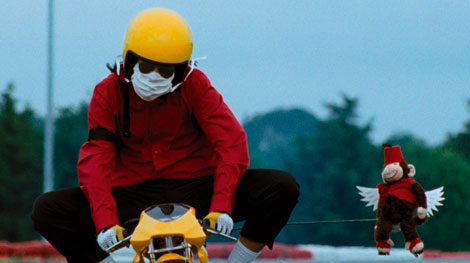
Werner Herzog makes another appearance, this time as an overzealous but well-meaning missionary somewhere in the Spanish-speaking jungle. See this film, if for no other reason than to experience his introductory scene—not so much a Harmony move, but more of a classic Herzog one. A local man (this is all documentary footage, I'm guessing, probably just a local Panamanian hanging around the set that they befriended) is prompted to confess his infidelity and plead forgiveness from Father Herzog, in costume with the camera rolling. The man eventually admits to having cheated on a woman, while tears stream down his cheeks. Herzog plays it straight, says a prayer in Latin, and absolves the man of all sin. Un-fucking-real. Next are the nuns, falling out of airplanes unscathed, basking in God's grace as they careen through the grainy blue sky on bicycles in some of the most beautiful photography of the film. Of the film? Try "of the year," for that matter. Cinematographer Marcel Zyskind is a usual Michael Winterbottom collaborator, and A propos, definitely take a look at both of these guys' work. Mister Lonely's photography is absolutely gorgeous, though. Highlight of the film by far. In the spirit of indulgence Zyskind goes old school, uses big-ass lenses, with shallow depths of field, loves slow motion, gets a little grainier than Gummo's Escoffier (may he rest in peace), but not as much as julien d-boy's Anthony Dod Mantle, a DP Zyskind worked for on 28 Days Later as it turns out. Take one look at the opening shot, Diego Luna's Dangerous-era Michael Jackson riding a tiny motorbike with a stuffed monkey attached to the back, all coming at you in ultra-slo-mo. Un-fucking-real.

Harmony spoke at Saturday's screening as well: "After tonight, I'm going to go home and write another movie. I'm not going to be so precious about things any more." In regards to his body of work, he took the words right out of my mouth. And in regards to the other movie, I'm certainly looking forward to it.

Awesome things I didn't mention:
Denis Lavant as Charlie Chaplin was great.
Leos Carax as a creep was perfect.
Samantha Morton gained weight for the Marilyn role, but she is still such a doll.
What was with the talking eggs?

Wednesday, May 7, 2008

My Winnipeg


Written by Guy Maddin and George Toles
Directed by Guy Maddin
Canada; 2007


Winnipeg's night skyline is framed by the window of Mr. Maddin's (played by an actor but actually narrated by the filmmaker himself this time) sleeper car on a passenger train on an endless loop around the city, like a thought bubble above his restless noggin. You sure can't take the city out of the boy, but apparently you can't quite take the boy out of the city, either. The loop is something of a fitting metaphor for the paradox of light rail in North America, where the Canadian public transit ridership is two to three times what it is in comparable American cities, but the public spending on infrastructure and upkeep in Canada is only about half that of its southern neighbor. That's a hard, sourced fact, something Mr. Maddin certainly won't give you. Disproving truth, or what cinema conventions would usually tell us is true, is basically his m.o., and in this newest film he's taken it to the next level, telling flat out lies about his hometown and its history. This self-narrated hodgepodge of experimental docu-fantasia (that's the term he uses) describes what we Americans would recognize as the de-industrialized capital of a midwestern swing state (do they have those in Canada?). The city has fared well, it seems, through a mad century of capitalization and subsequent demolition at the hands of those storybook robber barons, the department store speculators.

Those robber barons. Robber barons that have subsequently demolished the city. This narrated track (I'm so upset I missed the live narration performed only once at Tribeca this year, by the way. I was probably at that stupid Pangea Day thing. Doesn't anyone else see this crap as globalization? Anyway...) this narrated track is written with such repetitive eloquence. The phrases and rephrases are almost like chapter headings. At this point in Guy Maddin's career, though, his stylistic moves are no longer groundbreaking, and really only serve as branding while we experience the unique elements of each piece. It is exactly this fact that allows My Winnipeg to work so nicely as an essay, for one, because it's not necessarily about putting together a cohesive film experience, but more about reconciling a specific set of ideas while the hodgepodge illustrates. This is a technique perfected from the inside out by Su Friedrich in 1990's Sink or Swim, a film in which Freudian parent-child relationships, personal insecurities, and the idea of the innocent persona in the big bad world are all intellectual and emotional issues (as in Maddin's best work, Careful, The Heart of the World, My Father is 100 Years Old), rather than, however funny, mere jokes (as in his less successful Cowards Bend the Knee, and Brand Upon the Brain!). There are extremely funny moments here, especially during the NHL sequences and the domestic reenactments, which are both somehow bizarre and familiar at the same time, recalling the very best David Lynch moments, or perhaps a Kurt Vonnegut description of a dying family in a dying city. This is another move in the right direction for Maddin, and if his methods—once so mind-blowing but now old hat—can keep pace with his mad rush of ideas, than we can expect the delights to continue.

Tuesday, May 6, 2008

Profit Motive and the Whispering Wind


Written and Directed by John Gianvito
USA; 2007


A sad quality of Americana is that it's only a celebration of a diffuse slice of our history, the one in which Henry Ford's preserved historical villages don't include union organizer meetings, Norman Rockwell's The Problem We All Live With doesn't include cops spraying lunch counter patrons with firehouses, and Superman fights communists while holding down a day job as a yellow journalist. It's a sad fact, too, that most history books tell the rich people's established version of history, perhaps because it's easier to research than it is to launch investigations into how the other half lived. Just ask Howard Zinn what kind of a process that involves, or ask Chris Harman. Uncovering what the ruling class would have preferred us to forget is borderline revolutionary! There are so many people that history has forgotten to mention, either out of laziness or a concentrated effort by powerful interests, that it doesn't seem at all possible for it not to repeat itself. And when we're talking about business interests, isn't that the idea? Andrew Carnegie named a school after himself, Reagan branded an economic paradigm, and Sam Walton's legacy is as strong as his market share, but what kind of institutions are keeping alive the name of Lucretia Mott? How many students learn the name of Uriah Smith Stephens, the founder of the Knights of Labor, one of the first successful national labor unions in the country? This national hero is buried in an unmarked grave in Philadelphia. Not only has history misplaced him, but it has also failed even to label his remains.

John Gianvito's stunning Profit Motive and the Whispering Wind was the New York Society of Film Critics' Best Experimental Film of 2007, and rightly so. Here is a dedicated soul, and passionate filmmaker, who not only knows how to construct a powerful cinematic experience, but is also one of the rare historians willing to trek through miles of weeds and historical records in order to find these unmarked graves. Gianvito, a teacher at Emerson, set about to make a very different kind of documentary, but was taken aback by the kind of treatment history has shown not only the two aforementioned heroes, but dozens of others including Henry David Throeau, Soujourner Truth, Fanny Lou Hamer, Cesar Chavez... the list goes on and on. Gianvito decided to concentrate only on the earthly remains of these labor organizers, civil rights activists, and humanitarians. PMATWW inter-cuts between snippets of the lonely grave sites and the delicate movement of wind through the pines and the grass that usually provide Americana with an artificial warmth. Under Gianvito's discerning video lens, these elements are quite cold and become quite eery by the end of the hour-long piece. Occasionally through the trees or behind a particular memorial we catch a glimpse of a McDonalds, or a WalMart. The end sequence is punctuated by common protest signs, popular movement, and community organization. Slowly, the title becomes that much more pertinent, and the loud cracking of the drums shakes us to the depths of our moral hearts. The film is dedicated to Howard Zinn's A People's History of the United States, and Gianvito is pleading with us not to forget those lessons learned therein.

Thursday, May 1, 2008

Standard Operating Procedure


Written and Directed by Errol Morris
USA; 2008


We're at a cultural point where intellectual coolness, a plea for middle America humanism, and blogs in the NY Times about the vague metaphysics of documentary photography can't justify a failure to make a real statement about why things are wrong in the world and who are the culprits. Mr. Morris, at a talkback after the Tribeca premier of his latest piece of polished softcore, made for great entertainment by pointing his finger to the ceiling and shouting in his characteristically cartoonish timbre (perhaps what the offspring of Betty Boop and Foghorn Leghorn would sound like): "This thing goes all the way to the top!" Apparently the PFC's responsible for the Abu Ghraib debacle can rest easy, because according to Errol Morris, George W. signed the Code Red. He also went on to name a CIA member involved in the torture proceedings hinted at in Standard Operating Procedure, although none of this stuff is in the actual film. He continued to generally made a bleeding heart lefty case for the untold human story. Sorry, Errol, but while 1999's Mr. Death was saved by a fascinating fringe aspect and the fact that Holocaust Revisionists are hardly ever taken seriously, in 2003 you had the devil himself on the stand and couldn't, or wouldn't, make him say what every progressive thinker in this country needed to hear. The Fog of War backed down from what could have been a revelation from the life of former Defense Secretary Robert McNamara, rather than a watered-down "lesson" where, among other silly pontificating, the modern world's colonial rottweiler tried to take Ralph Nader's credit for automobile safety rather than admit that it was he who orchestrated and perpetuated the Vietnam War, America's biggest ever foreign policy failure. Well, second biggest at least.

Which brings us to Iraq. Morris described at the Tribeca screening how he couldn't gain clearance for interviews with any of Abu Ghraib's offending GI's, nor did he find any Iraqis involved in the incidents, nor would any high-ranking US officials speak to his Interrotron (the camera and video playback system he uses for interviews so that it appears his subjects are speaking directly to the audience). I'm genuinely surprised nobody over in the Bush clubhouse would speak with him, considering how good he made McNamara look in 2003. Bush Sr. and his buddies are perfect protégés of the original empire gangster, maybe they could have used an Errol Morris film to improve public image in the eyes of lefties who cling to Errol Morris and his political jello-spine in the same way that people who shop at Whole Foods and build giant houses in the middle of untouched forests think they're environmentally-conscious. Anyway, Morris couldn't get any of those really good interviews, so he put together a crappy humanist story about the innocent 21-year-old privates who didn't do enough jail time for their lack of decency. He also made some half-assed comments about the power of photography and its ability to tell a story (but, shocking! it's not the whole story). Slap some Robert Richardson photography in there, close-ups of blood drops, an ace with Saddam's face, and a paper shredder. Call up Danny Elfman and ask him if he can do a Philip Glass impression. You've got yourself another hit, man. But instead of a real money shot, we're left only with simulated. Errol Morris is becoming the Shannon Tweed of the doc world.

Thursday, April 10, 2008

i saw this first...

My Blueberry Nights,
just in case you missed it. I saw this during its Asia release, because my life is so glamorous I spent four nights in Singapore catching up on movies..

Wednesday, April 9, 2008

Boarding Gate


written and directed by Olivier Assayas
France, Luxembourg, 2007


Sandra blurts out the point so obviously in the second scene that it completely takes the fun out of the subsequent ones. "You always got harder when you told me what we were going to do than you did when we actually did it." Great line, though. The story is more interesting in between the action sequences—of which there are few. I'm hoping, though, that this isn't merely an effect caused by Sandra's appearances in lingerie—of which there are many. Olivier Assayas' latest film in a career-tainting string of disappointments after 1996's Irma Vep (although I quite liked his Paris, je t'aime segment) flirts with redemption in a way similar to main character Sandra's vain, last-ditch attempt at the same. Assayas continues in BG to plug seedy sexual attractions, B-movie genre bends (self-admitted this time, as if he needs to remind everyone why he keeps making films at all?), and an anti-bombshell femme fatale into his usual formula. The resulting meta-fest ends up with its lead actors simply chasing each other around the x-axis, taking turns in the focus range. It resembles less an exploitation film and more a Directing for Film 101 final project. At least it's interesting until we decide who's chasing whom. One talent of Assayas', like so many critics-turned-filmmakers, is he really makes an audience leave the theater feeling smart as long as they understand what the hell just happened. Sandra whored herself around for a long time in her twenties, and now that she's burned out in her thirties she seeks, through that same lifestyle, to phase herself out of the game. Simple.

Asia Argento is so terrifyingly attractive, I'll forgive her butchering this potentially effective script. The photography and soundtrack fall under the same category. That is to say, effective on the surface. Assayas and fellow heady shooter Yorick Le Saux (I don't really know much of this guy's work. I only say "heady" because he's French, too) keep things either too dark to see far enough into the scene, or are careful to keep a sharp focus only on the foreground, leaving the rest completely indecipherable. An easy visual metaphor for surface beauty. For such a complex filmmaker, Assayas' techniques are usually fairly straightforward when broken down. Asia Argento is so terrifyingly attractive, I'll...(did I say this already?) Moving on, Asia Argento is so... I just can't shake it.

Anyway, Asia has been excellent before. I call in question The Heart is Deceitful Above All Things, a film where she played a convict with the kind of conviction it takes to bring to life not just a bad-girl (which she is anyway), but a real embodiment of desperation. BG doesn't see her with any commitment to this world. I'd call it a problem with theory-devotional filmmaking. Argento's foray into filmmaking shows something like holistic ignorance of a critical reception. It's a don't know/don't care attitude that really keeps a film like that one breathing. This one, like the rest of Assayas' career, is marked by a fear of commitment. Non-film theorists often make the best filmmakers. And for the record, in regards to Assayas' non-actors, well, let's just say Kim Gordon was WAY better on stage.