Friday, February 22, 2008

The Diving Bell and the Butterfly


directed by Julian Schnabel
written by Ronald Harwood
novel by Jean-Dominique Bauby
France, USA 2007

The first act feels abbreviated, as if Elle editor Jean-Dominique Bauby could actually will himself into acceptance of this condition on the strength of his considerable charisma. The man rocketed through an explosion of prestigious fame and fortune before his stroke, and in an inspiring way, rather than a rock star sequence coming to a crashing halt, this momentum seems to carry him through the initial shock and adjustment process, the Dark Passage of dealing with a delibitating event. Spielberg's photo man Janusz Kaminski shoots from a one-eyed perspective with mesmerizing focus pulls and pivot games. His and director Julian Schnabel's emphasis throughout these tender opening scenes is so obviously focused more on a visceral delivery of the Bauby experience than anything else, perhaps in hopes of somehow bringing to life that connection between sensory perception and imagination, body and mind. The man's body, though--as is revealed in the (frustratingly mostly expository) subsequent scenes--is secondary to what has formed him as a professional and as a man. A debilitating condition has the effect of bringing issues of human composition to the table. With such limited expressive capabilities, what is it that makes up the man? Schnabel's butterfly theme crowds the frame with light, pretty people, poetry, and an array of the Sun King extravagance of Versailles. Distracted from the more human attention usually given to cinematic in-patients, one must assume that Bauby's verve and consequent success, both post- and pre-trauma, can be attributed merely to his acceptance of the aristocracy. Before the sickness, rich people danced pirouettes around him, and after the sickness, rich people continued the act.


Schnabel's first film, 1996's Basquiat, told a similar story from a different perspective. Jean Michel Basquiat encountered that same doting personality upon his entry into the New York Gallery scene. A nobody to begin with, and a natural iconoclast, Basquiat eventually rejected the aristocracy that wanted nothing more than to buy and sell him in the name of humanism. Jean-Do Bauby's success, though, was built on harnessing this energy and putting it up at retail prices. A speedy and opportunistic adjustment to a life-changing event, something Basquiat failed to achieve, marks Bauby's saga. It's a fine story, even inspirational, but isn't it just the aristocrat in all of us that can appreciate it on that level?

Friday, February 15, 2008

Michael Clayton


written and directed by Tony Gilroy
USA 2007


Rather than just another issue-based left hook, Michael Clayton delivers a more cinematic glimpse at the underbelly of an otherwise canopied corporate world. Although the plot centers around a law firm and its mega-corporate client's criminal negligence, writer-now-director Tony Gilroy concentrates instead on the upper level power struggles involved, and deftfully brings to life an exciting interplay of major corporate movers and shakers. You might think this sounds like an irresponsible blockbuster stunt, going so far as to foresake its centripetal issue (corporate greed and the human costs), but happily this film is refreshingly far from typical Hollywood material. Gilroy keeps the morality theme interesting by removing his titular character one step from the dilemma of conscience (Clayton is played by an ever-resourceful George Clooney, who has mastered the puppy-dog trick of channeling a tendency to appear vulnerable into shere loveableness). The guy with the dilemma is Tom Wilkinson's Arthur Edens, something of a Peter Finch character from 1976's Network, who spits hellfire and brimstone at Clayton eventually in vain. Clayton is unaffected not because he's a cold corporate drone, but because he has a kid, a mortgage, debt, retirement anxiety, a family member with a personal problem. He's dealing with a lot of stressful shit, and now you're asking him to care about humanity?

If these things sound familiar it's because they happen to just about everybody. Gilroy attempts to show that these big money Rock 'Em Sock 'Em Corporate Robots have issues like the rest of us, and they're just trying to stay afloat in the arduous journey that is life. Corporate interests aren't happy when they poison communities with byproducts, but they're locked into a system that forces them to put aside morals in the name of personal stability.

Gilroy takes it too far, though. The end is a pitiful Hollywood bit of wrapped-up closure, where Clayton and the rest of those on the correct end of the moral spectrum get back at the bad guys. The point is that everyone is a victim, even those bad ones. The system is the problem, and Gilroy makes no further attempt to examine it. His cinema chops are fine, and it's a nice ride while it lasts, but it's almost as if this director is another character in his own story. He's got a job to do, a career, probably a family, etc. Eden's ethically-charged ranting falls on Gilroy's deaf ears, too, and though a nice film comes out of it, the issue is completely gone.

Tuesday, February 12, 2008

No Country For Old Men


written and directed by Joel Coen and Ethan Coen
novel by Cormac McCarthy
USA 2007


I finally decided what nails me about this film, and it was only after something my friend Brian mentioned. The Coen brothers prove to be masterful nearly all of the time, combining taste and imagination with solid physical delivery of information within the film, for instance a dog chasing a man down a river is not only an awesome idea while the physical sights and sounds of it are pretty awesome in themselves. This is a usually unnamed feat that marks great filmmaking but in the Coen universe is held in higher regard than the film itself. It's similar to movies seriously immersed in genre, but the essential difference is that in those films thematic material--i.e. the message of the filmmaker--is allowed to surface due to that genre adherence, while in Coen work this thematic material gets completely lost. Any themes that exist in No Country, because they certainly exist, come across as some kind of sideline attraction on a cinematic rollercoaster.

The idealogy of competitive men, that violent motivation that runs the world and in a significant majority of cases supercedes that of all other human sects, including women, children, socialists, etc., is once again on full display. Can you name a 2007 film that doesn't, for lack of a better term, fetishize human masculinity? In the case of No Country this reliance on such a thematic mainstay is the only reason the film actually leaves any resonance. We pay rapt attention to the man-dance on stage and whatever existential struggle that plays out is unfortunately overshadowed by the many years of man that came before. OK, I'll admit it's about time existentialism is treated with the hilarious irony it deserves. Rather than some Sam Shepherd world, taken a shade too seriously, Cormac McCarthy's story bounces not only with the absurd humor of founding thinkers like Ionesco and Albee, but somehow these days this absurdity makes complete ironic sense. Either way, there's some solid filmmaking here that only seems to get in the way of it all.

Tuesday, February 5, 2008

There Will Be Blood


directed by Paul Thomas Anderson
screenplay by Paul Thomas Anderson
novel by Upton Sinclair
USA 2007


Rather than stick to the usual Daniel Day-Lewis program of: 1) point camera, 2) record every sound out of his mouth, and 3) sit back and watch, P.T. Anderson has once again proven his considerable directorial skill by harnessing the presence of this master of method-acting into just another tool in his sizeable kit. The opening shot explicitly demonstrates Anderson's control over the turn-of-the-century world he creates, blasting discordant sounds that resemble music over a rugged landscape. It's an old move (like one of my favorites, Peter Weir's Picnic at Hanging Rock), but like all of Anderson's moves, he executes it with such taste and discretion so as to nicely garnish his storytelling. Very soon after, Daniel's body lies at the bottom of the well-shaft, the crude itself glistening in what little light filters in, an omen of riches to come. For a second, there's no plot or narrative content as the gems of oily reflected light dance around, and the crude oil itself is the scene-stealer, a reminder that even the great Daniel Day-Lewis/ Daniel Plainview, both actor and character, despite such power and resilience, are but a drop in a barrel in this world. Anderson proceeds to out-frame, under-light, and exert countless other subtle strategies toward his leading man in order to further embed him in the picture.

Radiohead's Jonny Greenwood punctuates the film nicely with an interesting take on a jazz fusion/modern chamber music score. The horns and sax reminisce the best bits of Punch Drunk Love, though the violin often seems heavy-handed.

The theme is slightly confusing when the film takes its departure from the spirit of Upton Sinclair, on whose story the screenplay is based. Where Sinclair was an unrelenting, trust-busting social activist, P.T. Anderson is an entertainer. Daniel Plainview's story, quite deliberately, is not representative of the oil industry, an industry that today earns record-setting profits and has absolute dominance over the entirety of human society. When Plainview refuses Standard Oil's million-dollar offer, he becomes something other than this industry. His snide quips about Standard owning the railroads is Anderson's sliver of social commentary, perhaps dividing the world of capitalism into Old money vs. New money, and illuminating a fringe element of humanity therein. The titular blood is spilled by a capitalist renegade, a new-money man, and a fierce competitor, not by the old-money establishment. What's left after the blood is clear is just another well-told character piece, pulling its punches at some truly great opportunities to break into the dirty mind of state-sponsored capitalism.

My Blueberry Nights


directed by Wong Kar-Wai
written by Won Kar-Wai and Lawrence Block
Hong Kong, China, France 2007


So I come to Hong Kong, and Wong Kar-Wai goes to New York. Maybe we both needed to tread water for a little while.

Craftsmanship has always been idealogically divided against itself. The perfection of mass production is balanced by the imperfection of authenticity. Likewise, in the past Wong Kar Wai's strict formalist visual tendencies (i.e. In the Mood for Love, 2046) have made for such flawless delivery, while his playful chaos of shutter speed effects and hand-held trickery (i.e. Chungking Express, Fallen Angles) has beautifully roughened the edges of his ouevre.

My Blueberry Nights may be Wong's first to attempt a reconciliation of these contrasting styles, and he is aware of the craftsman's existential trap. Norah Jones gives a perfectly atrocious performance as Lizzie, an impossibly naive fish out of water, despite hailing from New York of all places. Wong's foray into the American experience is so wonderfully similar, a non-actress fills this title role with that universal authenticity of imperfection. To Jones' credit, this script is so clunky that even naturals Jude Law and Natalie Portman can't escape without some black and blues. But the blacker the blueberry, the sweeter the juice, and Wong seems to run with the idea, forsaking naturalist dialogue for a few excellent lines between clunks ("I'm the king of the white chips," "I beat that game on its ass!"). It's another extension of his reconciliation, like some impossible-to-deliver David Mamet script; stumbling gives the auteur some cred.

The theme of dishonesty is so auspicious in this film, as well. It's not only that Jones can't sell her lines, or that much of these characters' backstories is left unsaid. It's hard to believe that Leslie in fact beat that game, or that Lizzie really was mugged on the subway, or even that Jeremy's key stories are all true. Like Wong himself, his characters struggle with success. A winning image isn't authentic. It's only when we've been roughed around the edges that we've actually lived through something.

Monday, October 1, 2007

Eastern Promises


directed by David Cronenberg
written by Steven Knight
UK, Canada, USA 2007


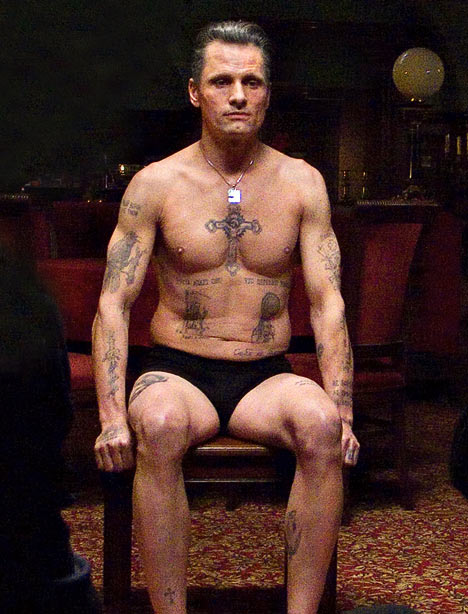
David Cronenberg's new film is most definitely not one to be messed with. Nikolai, played by an intense Viggo Mortensen, makes all attempts to hold true to an old school warrior's code of ethics, unflinchingly chopping fingers, stabbing enemies in the eyes, and selling out friends and family in the name of masculine domination of the hierarchy. His vertical mobility within the establishment, in the face of some tough decisions, is an almost perfect representation of Western values today. So many references to the KGB (one of the most badass real-life organizations in the history of societal regulation) as weak and worthy of scoff and scorn could only be seen as a major slight, and likewise a major assertion that for all those years behind the iron curtain there was an even more badass masculinity in charge - the mob.

The Russian mob, though virtuous in all the ways that make Western Capitalism such a potent and patriarchal sovereignty, apparently still embodies some of the mystique of the more spiritual hemisphere. This is a mere side note in Cronenberg's film, albeit an interesting one. The violent and self-gratifying value system adopted by a willing Nikolai, in the name of a more traditionally noble cause, is a much more powerful statement.

Not only is sexual dominance at the forefront of this excellent and thrilling story, but the phenomenon of sexual attraction can't help but surface. The violence in this film is pornographic in nature, as in much of Cronenberg's work, but Nikolai's sexiness lies in his domination of his environment, both physically and socially. Vincent Cassel's Kirill can't keep his hands off the guy, automatically responding to manipulation and force with acquiesence and devotion. The entire tradition of homophobia within this organization points directly to sexual politics and confused attractions. In Kirill's mixed-up world, he's not sure whether to respond to an alpha male with resistance or acceptance. If we're supposed to love a bad boy, how do we take it when he makes to destroy us?

It's the feminine world that balances this argument. Naomi Watts' Anna Ivanova refuses to love the badass Nikolai, and even to the end, she never learns the truth about the man. This doesn't matter. It's not about facts with sexual attraction, it's about attraction itself. The nice guy was in there, and in a healthy display of sexual preference, Anna refused to succomb to that sexy violence. Male domination has existed forever, but female judgment has consistently kept it in check.

NYC Public Schools on the Up and Up

Frank

So NYC just cashed in on the ED train in 2007.  Big money and big brains, or so it goes for the Big Apple these days in the elementary schools.  That's right, I'm talking about the Broad Prize, that hefty one million dollar award that ex-real estate mogul, Eli Broad, and his wife so generously pump into ameliorating urban public schools every year. It has finally been awarded to NYC!!!!  Good job Giuliani on making NYC safer for white people; the rich Manhattanites made their exodus onto 7th in Brooklyn safely, and now public education is soaring, that is after lowering the bench a little, too......... NYC's public schools are doing better!  The Broad Prize is an ostensible act of philanthropy  and is tantamount to Mr. Broad's chum, Bill Gates, and his generosity of pushing the envelope for smaller schools.  These two entrepreneurs should troubleshoot together for yet some more educational policy reform.  In fact they do!  They're pooling millions of dollars together to make their dream come true while simultaneously granting children's wishes for better proficiency in militaristic testing.  Let's gaze with wonder as these two venerating think-tanks work their magic of marginalizing the minds of youth, work towards privatizing the public schools, and flaunt millions of their hard earned tax cuts as they undermine the rest of us.  Oh yeah, they also got in touch with (paid) Kanye West to give a shout-out, it was as follows:  "Kids should go to school." ........... no seriously, he said that, what a fuckin' guy 'eh?

Sunday, September 16, 2007

Addressed to "The Times Argus" of Central Vermont

Frank

Following the occupation in Iraq a patriotism, obstinate in display, has blossomed in the U.S. I cringe at the playground diplomacy, the rhetoric spawned from the accretion of aggression, and opinions lack luster in reasoning and dense with irrational cogitation. I have crossed my fingers that these acts don't reflect upon me by default but now I have to speak, partly consequent of a Barre denizen who wrote in to express his opinion(s) of "dealing" with Iran. It was a puerile piece thick with anger and lacking facts.

Let us not forget that shortly after the events that took place on 9/11 Iranians congregated by the masses to hold a candlelight vigil for those who perished in the attacks. This gesture was quickly befogged weeks later after George W. Bush included the nation of Iran in his "Axis of Evil", an epithet for terrorist nations. It was then that Ahmadinejad began to mirror our very own president's ethics in foreign policy, albeit directed elsewhere, i.e., Israel, Syria, Lebanon, etc., and has evolved since. There are many topics up for debate pertaining to Iran, but straying from diplomacy and resorting to unilateral action is, in toto, an ill-advised decision that violates Geneva laws. Mandates aside, I believe it defies the canons of good behavior to air opinions aggressively and blindly.

We must recall that our shaping of the Middle-East for the past 60 years has resulted in a regional unrest directly contributing to an upshot in social/cultural disparity here and abroad, violent and non.

It was our interest in Iran that brought us to Iraq. In fact, Saddam was a beneficiary of U.S. funding and arms during the Iraq/Iran war, given permission and guidance to invade Iran. It wasn't until Saddam meddled with our own interests in the region that we turned our back on him and his regime. And have we forgotten that we were a sponsor of Saddam's war upon the Shiite population within his own country? Possibly in fear of Iran, being primarily Shiite, influencing Iraq's population and counter-insurgency - protecting its regional interests from hegemony? As for Israel, do people not know of Israeli-run torture chambers in Lebanon, that roughly 800 Palestinians are arrested and tortured by Israeli soldiers every year (according to Amnesty International), that their military power is the world's 3rd largest - a result of prime weapons deals from the U.S.? Or that there has been and is tremendous disparity in economic and military aid from the U.S. between Israel and the rest of the world when there surely has been other pressing humanitarian crises, i.e., Rwanda, Darfur, Congo, Timor, Bosnia, the list goes on and yet I'm sure I could find direct correlation between most humanitarian crises throughout the world and U.S. foreign policy. To sum it all up, occupying Iran is control over the Caspian Sea - control of the oil fields in the Middle East. Wilsonian ideology helped to point this out. There is no war on Islamic fundamentalism just fear and propaganda. If it were so, why aren't we flexing the same muscle towards Saudi Arabia, they're the most extreme Islamic state in the world? I'm sure it has to do with foreign oil investments. We are strategically protecting our assets and attempting to broaden them at the same time. Iran has a nuclear program. So do we, so does Russia, so does Israel, so do a lot of countries. Israel is as much of an aggressive threat as Iran is to the global economy and the Middle East, and let me point out that there are roughly 25,000 Jewish citizens in Iran that have claimed to be happy where they live (according to israelnn.com Iran has begun erecting a $3.2 million cultural center for the Jewish community in Tehran). Digression aside, nuclear proliferation needs to be subdued globally and not exclusively.

The foreign policy paradigm that our leaders have sworn by for decades does not work. It creates a cultural rift that could be a cultural bond. In Tom Wessels recent book "The Myth of Progress" he addresses in the beginning chapter that we need to re-evaluate our methods and paradigms, that the current ones are not sustainable to abide by. Like Wessels, I concur that paradigms work hand in hand, that is, foreign policy affects the economy which affects the environment and so forth. As a student seeking knowledge to help curb and redirect the current path of economic growth and promote the proliferation of the humanities I believe we need to transcend aggression and anger and ameliorate diplomacy. As we can see, anger accretes into atrocity. We lost thousands on 9/11 and by reacting through aggression that number of civilian casualties is reported monthly now in Iraq; do we really want to increase death by pursuing more conflict, subversive or not? In my opinion aggression is attributed to high levels of testosterone. According to a finding reported in the September 2007 edition of Harper's Magazine, "Men with high testosterone levels tend to be irrational negotiators."

Addressed to Central Vermont's "The World" Publication

Frank

I am writing in regard to the film-review column 'Max's View'. I want to politely state that I am not at all impressed with these puerile critiques of the visual medium; to declare bluntly, I have had enough of this finesse-lacking rubbish that is so easily pawned off to the World newspaper as worthy cinema reviews. I apologize for my harshness and repudiation but it is only consequent of the misinformation given and implied through 'Max's View'. Allow me to expatiate upon this opinion and perhaps kindle a dollop of inspiration and influence onto 'Max's' writing along the way. In the very least, perhaps he can learn a few new vocabulary words. And to the reader, I assure you I use only strong, hard-lined, evidence-based facts when writing an op-ed piece, unless however, I openly certify it a fallacy.

In Vol. 56 No. 15, 'Max's View' assesses the film "Sunshine", directed by briton Danny Boyle. The piece is filled with recycled comparisons, adages, and interpretations from the many film critics alike, appended is a rating of three stars (personally I would have awarded it two at the very most), and for the most part I agree with the critic in that the last fifteen minutes features that of a B-movie tingeing upon the public's thirst for violent pornagraphia shot with a shaky D.V. camera creating what I deem a photo montage translated through video! Motion picture aside, I am writing about the one original excerpt from this review and that is the tangent the writer chooses to open with - that the threat of global warming is only according to some environmentalists - and he goes on to contest this "wild theory" of "global warming" by stating: "Like most Americans, I have no desire to cut back on my driving or energy use in order to stave off some vague crisis that may occur generations down the road." Foremost, allow me to say that global warming is an imminent and real threat, it exists, and scientists - not just environmentalists - from around the globe will concur (except for the panel of scientists hired out through ExxonMobile to undermine supporting evidence and factual proof, i.e., data, charts, statistics, etc a while back when they launched a campaign of disinformation about climate change). But I don't need to chime what we already have and/or should have heard and learned, instead I would also like to address my lamentations over the review of Michael Moore's shockumentary, "Sicko" where the writer implored for Michael Moore to back off! and stop degrading America and start recognizing our nation for her worldly influence, that if it wasn't for our advancing intellect and innovative nature the rest of the world would be impoverished, left behind to deal with disease and medicine on a sub-prime level not equivalent to the ground breaking ingenuity we Americans have set as precedent in medicine, health care, and the whole agglomerate of sciences alike. Or at least I believe that was the implication meant to be conveyed to the reader. So I will keep this short and simple. It is benighted for any one individual to think and believe along/in the former and latter. Our nation ranks #36 from #1 in health care throughout the world, or so Michael Moore aptly pointed out, placing France and Italy within the top two slots. This could partly be on account of: All other major industrialized nations provide universal health coverage for their denizens; there is a large disparity in quality given to folks in different class brackets here in the U.S.; we have a large infant mortality rate; we rank low in nutrition, healthy-life expectancy, and according to an editorial in the N.Y. Times Aug. 12, 2007, we rank 15th among 19 countries in death from illnesses that would not have proven fatal if tended to effectively and in a timely manner; most of our health care infrastructure relies on paper records versus computers. This is all to name but a few.

Here are some brief updates of people and think-tanks NOT from the U.S. who are ameliorating the sciences and our lives: Prof. Amos Ori from Technion Israel Institute of Technology has made ground breaking advancements in theoretical sciences. He has devised a new model that poses a vacuum space consisting of positive density that will perhaps allow scientists to fabricate time-like curvatures in space so time travel can be a reality. In Geneva, Switzerland top scientists are constructing a particle accelerator where they will be forming miniature black holes to investigate string theory and study other theories surrounding dark matter and dark energy. The Max Planck Institute for Bio-Physical Chemistry in Gottingen, Germany leads the way in optical 3D far-field microscopy with nanoscale resolution - *this could be of important use in pathology and medicine perhaps. By the way, feel free to explore more where I retrieved this information at www.physorg.com
It is also astonishing to discover, when educating oneself in alternative waste disposal, the practice of anaerobic digestion in areas of Japan and Europe. Anaerobic digestion is a process that decomposes waste through anaerobic decomposition, in layman's terms - bacterial compost - in which bacteria feeds on the waste and in return emits methane - an alternative source of energy. This could perhaps settle the land fill debate in Williston, VT if practiced here.

In the June 2007 issue of Harpers magazine, Harpers Findings reports that researchers predict net moisture levels in the south western U.S. to drop 15% in the coming years resulting in severe drought due to global warming; scientists in Germany discovered that warmer oceans could cause the Earth to spin faster; that magnolias are near obsolete because of habitat destruction; and overfishing has led to the collapse of the shell fish industry. Max, if that's your real name, why do you insist on not cutting back on energy? This gluttonous act so many are guilty of seems almost to be in spite of the progressive intelligentsia and why? Our nation is trailing behind in health care, education, nutrition, environmental policy, and even diplomacy! to name a few, but we're doing pretty well with private enterprise, class disparity, and infrastructure collapse, all so uniform to ancient Rome's final days. If there's one thing that I've learned from watching film, it's that the world is a small place full of large ideas from all walks of life. You may be surprised to hear that I am but a month older than the age of 25 years and may wonder how, why, and where did I collect the wit, courage, facts, knowledge, etc. to provoke this literary debate? Well Max, I spent the better part of my cognitive years learning what the world has to teach and I would never give up my foreign relations or admiration of what another country has to share with me for a sense of patriotic pride. I leave you with this last tip to help aid your future opinions and critiques:

The opinion is a prolific force of nature, of mind, and of the individual. It is something we hold so dear and cherish, but yet we are so quick to toss it out amongst each other, to our neighbors, our students, our families and friends, our enemies and foes, our press and forums, etc. Each and every one of us yens to share an opinion and to influence. I just ask that before we decide to voice our own opinions, we soak up all the education we can and gather facts - misinformation is not only vexing but dangerous.

Tuesday, September 11, 2007

3:10 to Yuma

Watching Christian Bale stuck in a Hollywood-blocked character that literally could have been played by an actual, sticks-and-straw scarecrow with an attached hidden speaker pouring out some of the grittier dialogue pieces of Little House on the Prairie is not something I'm particularly interested in doing. Sitting through a Russell Crowe image vehicle, desperately waiting--eventually in vain--for a character of his to finally be killed off is similiarly disheartening. Allowing myself to fall victim to a cultural trend of Western-philia, a strange phenomenon that occasionally rears its head at unexpected moments, is downright confusing.

3:10 makes about as much sense plot-wise as the better half of the Bruce Willis catalogue, and falls on the moral spectrum somewhere between Forrest Gump and The Wizard of Oz. The central villain is Ben Foster's Charlie Prince, whose qualities include loyalty, intelligence, resourcefulness, and gratitude. Apparently, his downfall lies in camera angle, the intensity of his stare, and an ominous orchestral phrasing during his scenes. The hero is Bale's Dan Evans, an ineffective and dull Arizona rancher whose moral decisions are based on lawbooks written and enforced by his worst enemies--rich railroad men. Russell Crowe's charmingly ridiculous Ben Wade tap-dances his way across both sides of these moral questions and in the end is rewarded for selling out on the "loyalty among thieves" credo, arguably one of the most important story elements brought to us by the Western.

Treated with a higher degree of intelligence (or perhaps artistic freedom, since we're dealing with a Hollywood blockbuster-wannabee here), this script could have brought down the house in today's world of rich-poor exploitation, pornographic violence in media, and the masculine struggle, but instead the film is nothing more than lifted clichés and poorly-aimed gunshots.